
I’m an avid reader, and I love immersing myself in stories. I often wonder where authors find their inspiration, what their writing process actually is. Until I became a writer myself, I’d always thought of writing as a mental exercise, but that has not been my experience. There are times when I write from my head alone, but the words feel stilted, wooden. My best writing comes from somewhere deep inside me. The words bubble up and my mind is nothing more than a translator, guiding my fingers across the keyboard.
Writing the Gaea Remembered Series
Writing the Gaea Remembered Series began with visions and voices from the past. One reason there was such a time gap between my writing retreat in 2017 and returning to the work in 2025 was that the images and descriptions I was receiving didn’t match my knowledge of history. It wasn’t until COVID sent me spiralling down many dark rabbit holes (and others that were simply enlightening) that I came to believe much of what we’ve been taught, not just in history but in nearly everything, is not the truth. Since then, I’ve been able to sit in the uncertainty, the not knowing. And that has freed up my writing. The uploads I receive from Monia and possibly my higher self could well be the truth. And if not, they make a good story.
Intuition and Research
Daughter of the Solstice hasn’t been written from intuition and uploads alone. I knew very little about ancient Egypt, certainly not in the depth required to bring it to life through Monia’s eyes. So I’ve also done extensive research. I began with the practical questions any writer would ask:
- How long does it take to sail up the Nile from Alexandria to Memphis?
- What temples would Monia have passed?
- What would people have worn, eaten, seen along the way?
I used AI to gather facts and images, pages of information about ancient routes, architecture, climate, daily life. The research grounded me, where as my intuition and downloads enhanced the story with feeling, emotion and ancient wisdom that is rarely found in any research.
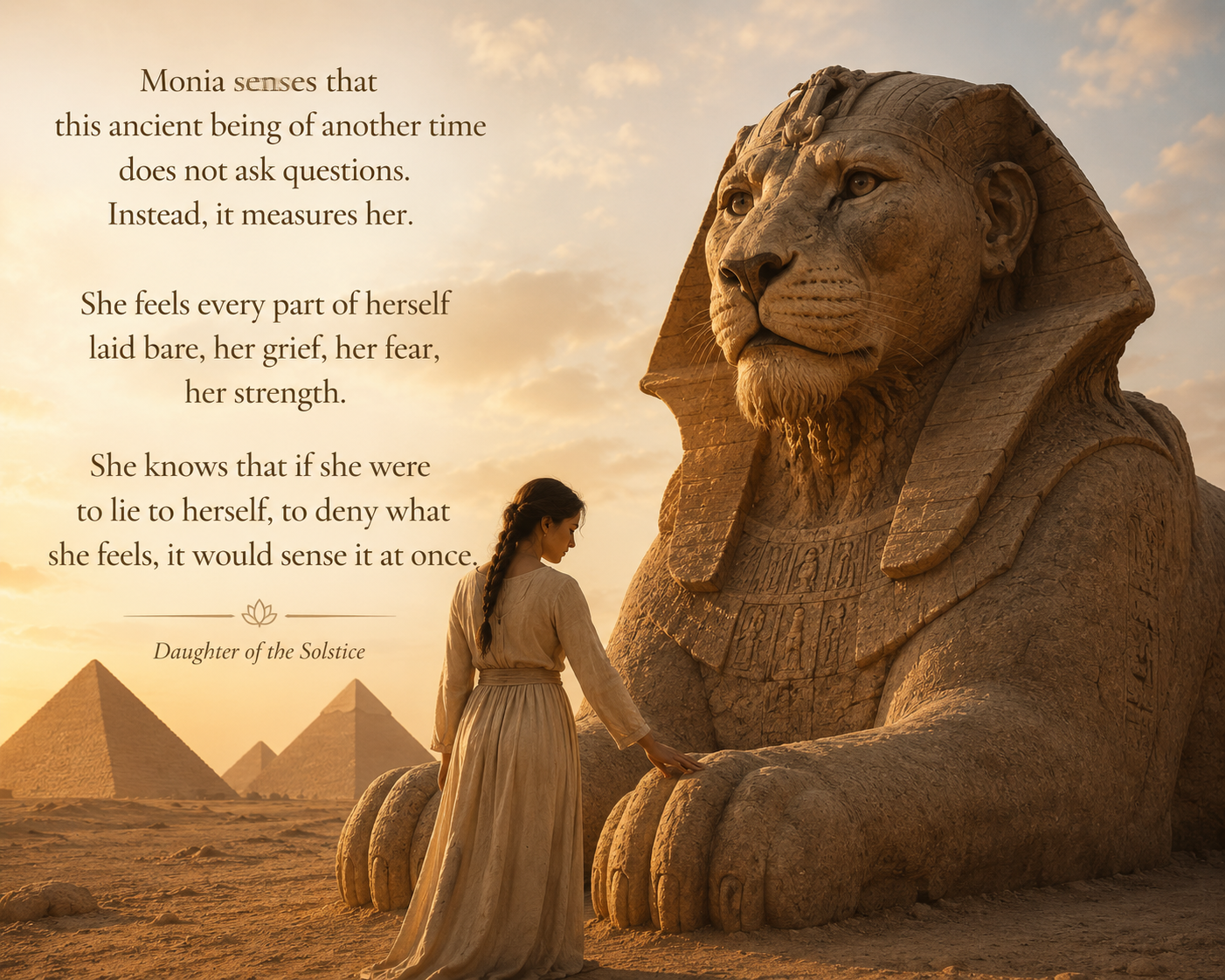
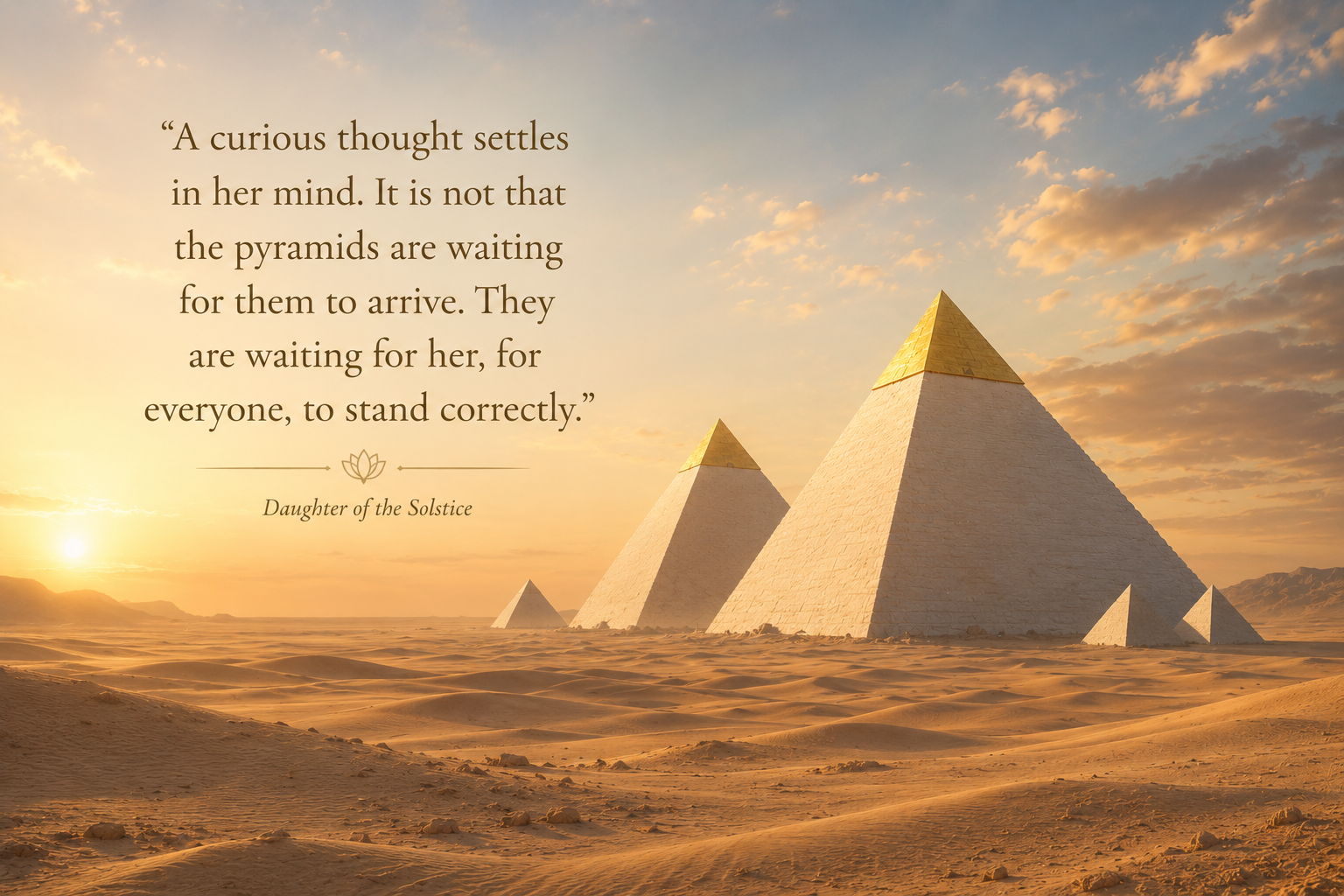
But as I wrote deeper into Monia’s consciousness, the images coming through weren’t always what the research showed me. She revealed a civilisation far more advanced than we’re typically taught. The pyramids weren’t tombs but energy amplifiers. Temples held knowledge we’ve forgotten. Ancient people understood things about consciousness, healing, and the Earth that our modern world has lost.
Facts and feelings
When Monia walks toward the Khufu Pyramid and places her hand on the limestone, she feels what the data alone could never show:
“This is not a tomb,” she says quietly.
Akhon does not reply at once. Then, softly, “No, it is not, though many believe it is.” He pauses, glancing around as if to be sure they are alone. “It is an energy magnifier. It draws power from the aether, the air’s energy so it may be used for light, for heat, but more importantly, it teaches the body how to hold greater light, greater truth, without fracturing.”
That comes from intuition. From listening to Monia. From trusting that ancient wisdom often lives outside the academic record.
So this is how I write: I listen to Monia (or my higher self), immersing myself in the visions and words. Then I research to fill in the gaps, to deepen my understanding, to build out descriptions of places and culture.
Monia watches the riverbanks drift past. Everything feels so different from her homeland. Then, in the distance, she spots something that looks like a stepped triangle, faintly shimmering in the heat, as though it is giving off a soft hum.
“Akhon, what’s that?”
“Ah,” he says, “that is the Step Pyramid of Saqqara. It is said to be the first great monument built of stone. Saqqara is where stone was taught to remember the sun. It was built for Pharaoh Djoser, and it is where he is buried. Beneath it lies a world of tunnels filled with offerings and symbolic objects, placed there to help him on his journey beyond.”
What draws you more: the version of history we were taught, or the one your intuition whispers?
Recent Comments